How to Measure Yourself for a Corset (And Actually Get the Right Size)
Just like buying a new bra, picking the right size corset requires careful measuring and a sometimes a bit of trial and error.
This guide walks you through exactly how to measure yourself for a corset or bodice, what those numbers actually mean in terms of fit, and how to navigate the sizing logic so you can order with confidence.

Not all corsets fit the same way
Before we get into tape measures and numbers, it's worth understanding that "corset" covers a wide range of garments, and they don't all approach fit the same way.
A dedicated waist training corset — the steel-boned kind built for dramatic reduction — is engineered to compress the waist by several inches. It requires careful break-in, called seasoning, and the sizing logic leans heavily on how much reduction you're going for.
Most of what we make at French Meadows falls into the bodice and stays category: historically inspired garments that follow and support the natural shape of your body rather than aggressively restructuring it. You'll still get that beautiful corseted silhouette, and yes, there's genuine waist definition — but the goal is a fit that's supportive and wearable all day rather than one that maxes out compression. The lacing gives you a range of adjustment, which means how tightly you wear it is partly a matter of personal preference, not just size.
This distinction is important because the sizing logic is a little different from what you might see on a waist training guide. Keep that in mind as you read through the recommendations below.
What you'll need
A soft fabric measuring tape -- the flexible kind used for sewing, not a hardware store tape measure. A rigid tape can't follow the curves of your body and will give you numbers that are slightly off in ways that compound across your measurements.
If you don't have one, a piece of string and a ruler work. Wrap the string, mark where it meets itself, then lay it flat and measure.
Wear a well-fitting bra, or no bra if that's how you plan to wear the garment. A padded or push-up bra will add volume that isn't really there and throw off your bust number. Stand straight but relaxed — arms at your sides, shoulders back naturally, not braced. And if you can, use a mirror to check that the tape is lying level around your back, or ask someone to help. A tape that dips or twists in the back can shave an inch or more off your actual measurement.
The measurements that matter

Bust
Wrap the tape around the fullest part of your chest — across the nipples — keeping it parallel to the floor the whole way around. Snug, not tight. Take a breath and measure on the exhale.
This is critical for overbust styles, which cover the chest. For underbust corsets and most bodice styles, the bust measurement helps determine how the upper edge of the garment will sit against your ribcage and whether the proportions will look right on your frame.

Natural Waist
This is the single most important measurement for corset and bodice sizing. It's what corset sizing is built upon.
Your natural waist is not where your pants sit. It's the narrowest part of your torso — typically about an inch above your belly button, roughly in line with your lowest floating rib. If you bend sideways, the crease that forms on your side is your natural waist.
Stand up straight, find that narrowest point, wrap the tape around it, and take the measurement. Don't suck in; don't push out. Just stand normally.
Don't have a defined narrow point of your waist? That's completely fine — corsets and bodices are made for every body shape, not just hourglass ones. If you have a fuller belly, carry weight through your midsection, or your torso is relatively straight from underbust to hip, the "narrowest point" method won't work for you, and forcing it will give you an inaccurate measurement.
In that case, measure about one inch above your belly button regardless of whether it's your narrowest point. This is the anatomical waist — the area the garment is built to sit at — and it's the right place to measure whether or not your body tapers there.

High hip
The high hip — also called the upper hip — is the measurement around your hip bones, roughly three to four inches below your natural waist. Use this measurement only for longer bodice styles and underbust corsets that extend over the hips.

How to use French Meadows' size chart
Each product listing on our site includes a size-specific chart, because measurements can vary slightly between styles. Don't assume that your size in one garment automatically translates to the same size in another — check the chart for the specific piece you're ordering.
Understanding ease
Here's the part that confuses most first-time buyers. Corset and bodice sizing isn't about matching the garment's dimensions to your body — it's about intentional sizing down so the garment can do its job of shaping and supporting.
This intentional difference between your body measurement and the garment measurement is called negative ease.
The recommendations in our size charts account for a moderate amount of negative ease. On our size charts, you will see a column labeled "Corset measurements." These explain what the actual measurement of the garment is. The difference between our recommended body measurements and the corset measurements demonstrates the amount of negative ease within each size.
If you want to fine tune the fit of your corset, view our Sizing Guide for more in depth information about how to pick the right amount of negative ease.


When bust and waist fall into different sizes
This is one of the most common sizing questions we get, and the answer is straightforward: prioritize the waist first.
The lacing gives you considerably more ability to adjust the bust than the waist. If your bust runs larger than the recommended range for your waist size, you can loosen the lacing at the top to accommodate it. A chemise or shift underneath can also add a little fullness or provide a smoother base if there's a slight gap at the top edge. For a smaller bust relative to your waist size, period-appropriate layering, padding, or a well-fitted shift can fill out the silhouette.
What you can't adjust as easily is the waist. The boning and structure are built around that point, and if the waist is the wrong size, no amount of lacing adjustment will make it sit right.
Tips for specific body types

Pronounced hourglass figures: If your hip measurement is significantly larger than your waist, opt for a style that ends at your natural waist. This way you won't have to deal with the hip measurement at all.
Straighter figures: If your hip and waist measurements are close together, consider choosing a style that adds a bit of flair or visual interest around the waist in order to create the illusion of an hourglass silhouette. Our Tabbed Tudor Stays, 18th Century Stays, and Ballerina Stays are great for this. You can also wear a bustle pad under your skirt or chemise to pad out your silhouette the historically accurate way.
Short torsos: Avoid styles that extend past the waist, like our underbust corsets. Opt instead for one of our shorter torso styles, like regency stays. You can also play with leaving a portion of the bottom of the corset unlaced, so it has room to flare out beyond your natural waist.
Larger bust to waist ratio: Consider an underbust corset, which does not need to fit your bust since it stops below it. Follow the sizing guide for your underbust measurement to get the best fit.

More tips for measuring
A few practical notes that make a real difference:
Measure at the end of the day, not the morning. Bodies are slightly larger after a day of moving around, eating, and sitting — measuring in the morning and then wearing the corset in the evening can mean a tighter fit than you expected.
Don't measure over bulky clothing. Even a single layer of a thick sweater can add half an inch or more to your measurements without you realizing it.
Retake your measurements if anything significant has changed — weight, pregnancy, muscle gain, or even just a long period since you last measured. Numbers shift, and a corset sized for your measurements from two years ago may not fit the way it should now.

After the garment arrives
Even with accurate measurements and careful size selection, a new corset or bodice may feel unfamiliar the first few times you wear it. The structure adjusts slightly to your body over the first several wears, and you'll find yourself naturally fine-tuning the lacing tension. Start a little looser than your target fit and work toward a tighter lacing over a few sessions rather than going for maximum cinch immediately.
If something feels genuinely wrong — boning digging into your ribs, the garment rolling up or down persistently, or significant fabric bunching that doesn't resolve with lacing adjustments — it may be a fit issue worth addressing. Reach out and we can help you troubleshoot whether a different size or a different style would serve you better.
The right size corset for you
Still not sure which size to get? If you’re still not sure about which size is right for your body measurements, send us an email and our team can make a recommendation for you. We’d be happy to help you pick out your dream corset!
Browse our full collection at French Meadows, including underbust corsets, overbust bodices, and historically inspired stays in sizes XXS through 5X. Not sure where to start? Our corset style guide and FAQ are good places to get your bearings before you buy.
Our Favorite Corsets
-
Leather Underbust Corset Belt
Regular price $58.00 USDRegular price -
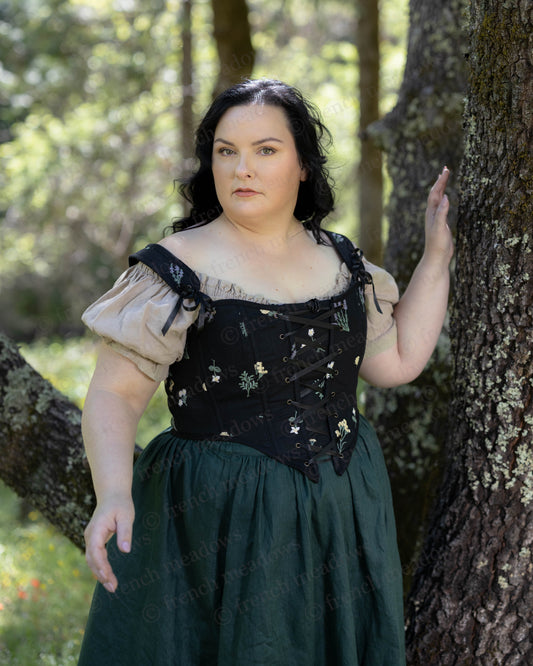
Black Wildflower Corset
Regular price $158.00 USDRegular price -
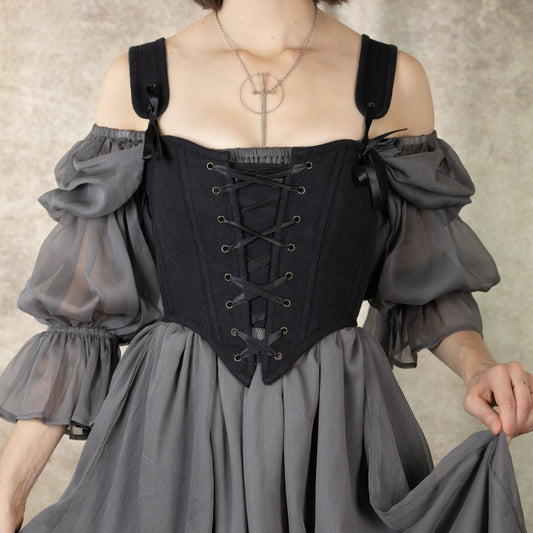
Black Cotton Corset
Regular price $132.00 USDRegular price -
Floral Tapestry Corset
Regular price $148.00 USDRegular price


Blog posts
View all-
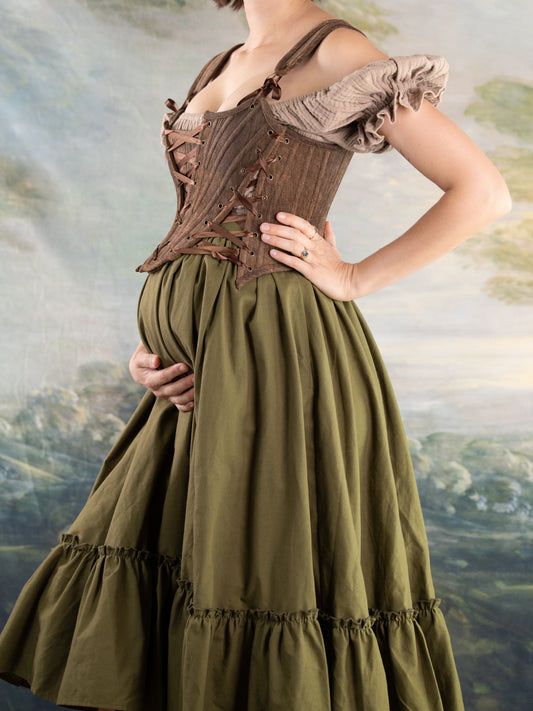
Maternity Renaissance Faire Costumes
Want to attend the renaissance faire during your pregnancy? Here's our complete guide on what to wear to the renaissance faire when pregnant. Hint, it's simpler than you'd think...
Maternity Renaissance Faire Costumes
Want to attend the renaissance faire during your pregnancy? Here's our complete guide on what to wear to the renaissance faire when pregnant. Hint, it's simpler than you'd think...
-

How to Measure Yourself for a Corset (And Actua...
Just like buying a new bra, picking the right size corset requires careful measuring and a sometimes a bit of trial and error. This guide walks you through exactly how...
How to Measure Yourself for a Corset (And Actua...
Just like buying a new bra, picking the right size corset requires careful measuring and a sometimes a bit of trial and error. This guide walks you through exactly how...
-
Bodice vs. Corset, What’s the Difference?
Here at French Meadows, you may have noticed that we use the terms bodice and corset interchangeably. That is because in the context of contemporary fashion, they are very similar...
Bodice vs. Corset, What’s the Difference?
Here at French Meadows, you may have noticed that we use the terms bodice and corset interchangeably. That is because in the context of contemporary fashion, they are very similar...

